
VideoOculography
Seeing How the Brain Moves
Our eyes do more than help you see — they reveal how your brain is working. Through videooculography (VOG), we can capture precise, high-speed recordings of your eye movements, giving real-time insights into how different parts of your brain communicate, process information, and regulate movement.
At SCC Neuro, we use the CogNuro™ System, an advanced videooculography and brain–body integration platform, to assess and improve the neurological pathways that govern focus, balance, coordination, and cognition.
Why Eye Movements Matter
Every eye movement — whether it’s tracking a target, shifting focus, or stabilizing your vision while turning your head — is controlled by highly specialized circuits involving your brainstem, cerebellum, cortex, and vestibular system.
If one or more of these pathways becomes disrupted due to injury, stress, or disease, it can lead to:
Dizziness or vertigo
Poor focus or slow reading speed
Visual fatigue or eye strain
Brain fog or motion sensitivity
Balance or coordination issues
By studying these eye movements, we can pinpoint where the communication problem begins in the brain — giving us a roadmap for improvement.
What Is the CogNuro™ VideoOculography System?
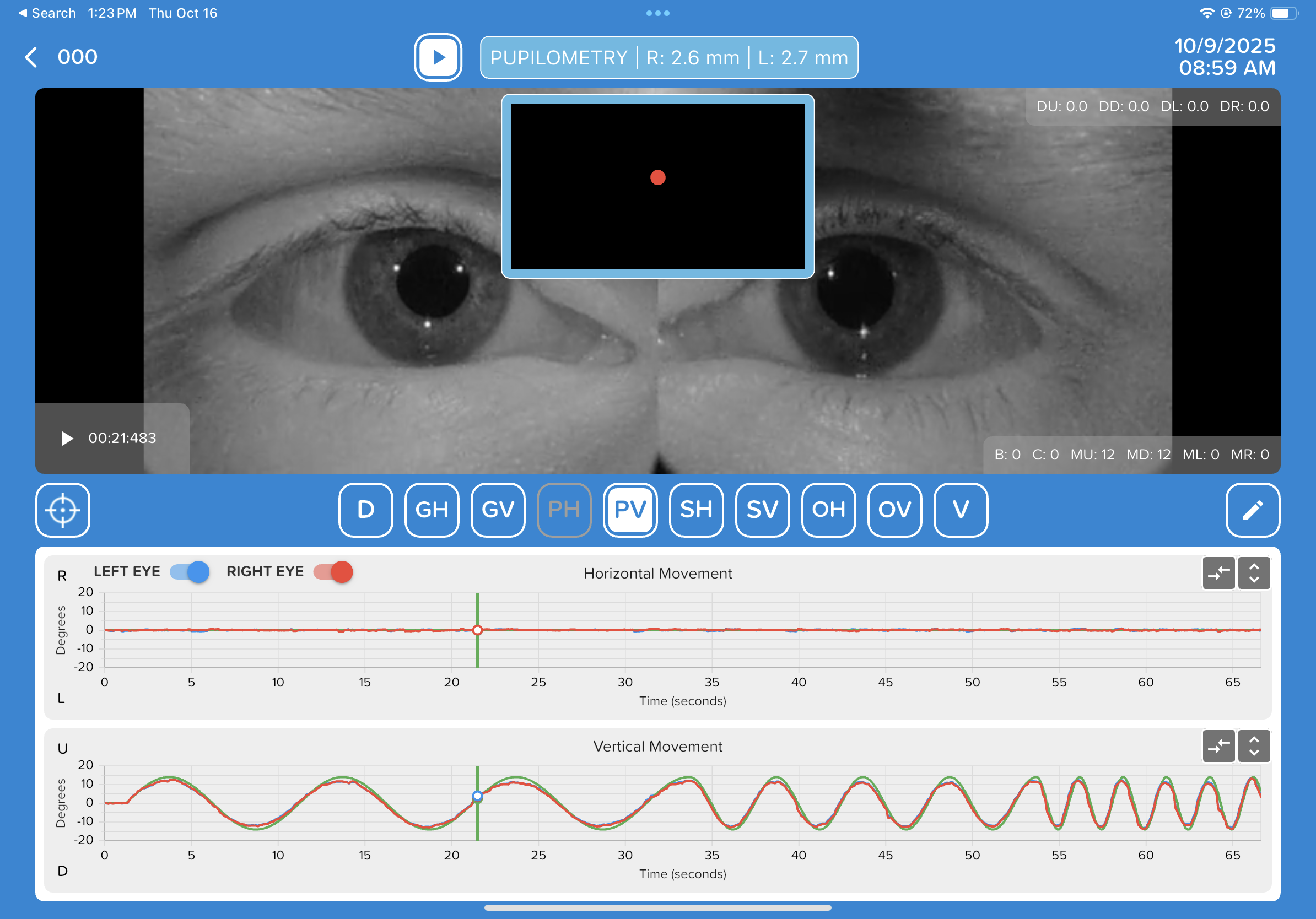
The CogNuro™ system uses infrared video recording to measure the movement, velocity, and precision of your eye responses. It tracks how your eyes fixate, follow, and reposition during specific neurological tasks.
This provides objective data that helps our clinicians identify:
Areas of underactivation or asymmetry in the brain
Cognitive and visual-motor challenges
Vestibular and cerebellar dysfunction
Stress-related dysautonomia and fatigue patterns
From Assessment to Rehabilitation
Once we understand how your eyes and brain are working together, we can design targeted rehabilitation plans that may include:
Oculomotor and gaze stabilization exercises
Head–eye coordination training
Balance and spatial orientation feedback
Cognitive-visual integration tasks
Vestibular recalibration protocols
These exercises stimulate and strengthen the specific brain circuits that need improvement, helping restore stability, focus, and mental clarity.
Why This Matters for You
For conditions like concussion, dizziness, brain fog, migraines, or post-stress fatigue, eye movement testing allows us to see what standard scans can’t — functional changes in real-time brain activity.
Through CogNuro™ videooculography, we can directly measure progress and adapt your treatment as your nervous system heals.
Precision Healing Powered by Neuroscience
The CogNuro™ system transforms how we understand your brain’s function. Each session provides insights not just about your eyes, but about how your entire nervous system communicates.
That means more accurate assessments, personalized rehabilitation, and more efficient recovery — whether your goal is to regain focus or reach elite mental performance.
VideoOculography and the CogNuro System in Functional Neurological Assessment and Rehabilitation
Videooculography (VOG) is among the most sensitive diagnostic tools in clinical neuroscience, providing quantitative data on central and peripheral oculomotor control.
At SCC Neuro, we utilize the CogNuro VOG system to precisely evaluate neurological network performance and guide targeted neurorehabilitation protocols.
This integrated system allows clinicians to assess dynamic eye movement responses with sub-millisecond accuracy, offering representational insight into brainstem, cerebellar, vestibular, and cortical circuitry involved in sensory integration and motor control.
Neurophysiological Foundations
Oculomotor activity serves as a real-time indicator of:
Cerebellar processing and timing coordination
Brainstem nuclei integrity affecting gaze control and VOR reflexes
Frontal eye field activation related to executive and attentional modulation
Vestibular network communication within the midbrain and cortex
Alterations in saccadic latency, pursuit velocity, accuracy, or fixation stability correspond to specific regional dysfunctions — forming a functional map for neurodiagnostic interpretation.
Clinical Applications
Videooculography provides a non-invasive, highly sensitive index for functional neurological conditions such as:
Traumatic brain injury and concussion
Post-concussive dizziness and balance disorders
Dysautonomia and postural orthostatic intolerance (via vestibulo-oculomotor coupling)
Migraine and visual motion hypersensitivity
Cognitive fatigue, eye strain, and performance inefficiency
The CogNuro platform captures micro-movements that often precede clinical symptoms, enabling early detection of neurological asymmetry and instability.
Diagnostic Precision
During a CogNuro VOG session, the system quantifies:
Horizontal and vertical saccadic latency and accuracy
Smooth pursuit gain
Optokinetic response consistency
Gaze fixation endurance
Vestibulo-ocular reflex (VOR) adaptation under dynamic conditions
Data are analyzed to reveal patterns of neural inefficiency or imbalance, which can then be directly addressed through therapeutic intervention.
Rehabilitative Integration
Eye movement is a powerful neuromodulatory stimulus. By incorporating customized oculomotor exercises, we can selectively activate underperforming neural pathways and restore network coherence.
Examples include:
Asymmetric saccadic loading for hemispheric activation
Smooth pursuit retraining for cerebellar modulation
Visual–vestibular–postural integration drills for balance recalibration
Gaze stabilization tasks for autonomic regulation
Repeated activation through these protocols induces neuroplastic adaptation—enhancing network speed, synchronization, and sensory integration across multiple brain regions.
Outcome Metrics
Objective improvements in oculomotor coordination correlate strongly with enhanced:
Cognitive processing efficiency
Postural stability and spatial orientation
Autonomic regulation
Multisensory integration
Attention control and endurance
These measurable outcomes confirm the role of targeted eye movement rehabilitation as a cornerstone of functional brain recovery and performance enhancement.
Why SCC Neuro
Clinicians trained in Functional Neurology and Oculomotor Rehabilitation
Use of CogNuro™ videooculography technology for quantitative analysis
Integrated application across concussion, dysautonomia, and performance optimization
Precision-guided rehabilitation built upon objective neurophysiological markers
Professional Collaboration
SCC Neuro collaborates with physicians, neurologists, and rehabilitation professionals seeking quantitative functional diagnostics and oculomotor-based neurorehabilitation protocols.